The Influence of Residual Ion Drift During Programming of Chip-Integrated Nanoscale HfO2-Based Memristive Devices
In the issue of Advanced Electronic Materials, 2026; e00891, a research team by Oliver Artner, Felix Cüppers, Seokki Son, Yang Chen, Xiaohua Liu, Christopher Bengel, Dennis Nielinger, André Zambanini, Stefan Wiefels, Stephan Menzel, Regina Dittmann, and Susanne Hoffmann-Eifert published the article “The Influence of Residual Ion Drift During Programming of Chip-Integrated Nanoscale HfO2-Based Memristive Devices”.
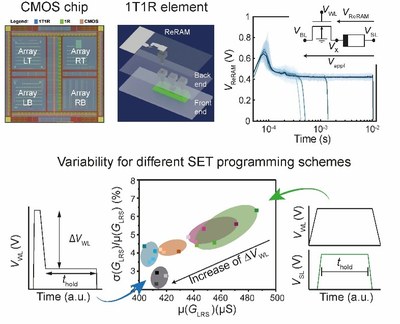
Computation-in-memory (CIM), implemented in 1T1R crossbar arrays comprising memristive devices and transistors, enables fast and energy-efficient computation in neuromorphic hardware. However, the huge dynamic range of memristors requires suitable programming algorithms to optimize computational accuracy and energy efficiency. As part of the BMFTR project NEUROTEC, the JUNCA institutes PGI-4, 7, 10 and IWE-2/RWTH provided a test chip in 180 nm CMOS technology, which was used in this study. Oliver Artner analyzed the transient SET behavior of HfO2 devices in a 1T1R configuration and demonstrated that residual ion drift during SET affects the level and variability of the programmed states, whilst the variability could be reduced by a controlled decrease of the transistor’s gate voltage.
DOI: https://doi.org/10.1002/aelm.202500891